How to Draw a Norway Maple Leaf Easy
The maple leaf looks like an open hand. The botanical name "Acer" (Latin for "sharp") was given to the plant by the ancient Roman scientist Pliny. According to some researchers, maples grew along the banks of the river of sorrow, Acheron, through which the souls of the dead Greeks crossed on their last journey. In most cultures around the world, maple is considered a symbol of autumn. In Japan, this tree symbolizes eternity, learning, life wisdom. Therefore, it is often planted in their gardens by older people with great life experience. The Germans associate it with the beauty of life. Before the funeral, the Poles laid their dead on unpainted maple wood: it was believed that this would scare the devil away.
The Serbs believed that the maple would help restore justice: the tree would turn green from the embrace of an innocently convicted person. In folklore, maple is often called sycamore. It was believed that a person who was "sworn" turns into this tree. Therefore, just in case, they did not use maple firewood for kindling the stove, making utensils and coffins, and when baking bread in the oven, they did not put maple leaves under the loaf.
But in the old days, the legendary harp was made from maple, and in our time - bassoons, guitars and drums. The Slavs believed that musical instruments from sycamore sing and cry, complaining about fate. On Trinity and other holidays, it was customary to decorate houses with maple branches so that the souls of dead relatives could fly to the living, hiding among the branches. Some folklorists are convinced that it was sycamore that was the sacred tree among the Slavs, since references to maple are found in all regions, and the use of the names of other trees has a pronounced localization.
In Russian villages, there was an interesting tradition - "threading through maple". A newborn child was "threaded" between the branches of a maple tree so that his life would be long. Those who believe in the special energy of plants are convinced that maple is able to "caress" a person, bring peace of mind. The tree takes on human emotions, sometimes without our desire. Therefore, under the crown of a maple, it is good to relieve stress and it is bad to declare love. The maple alley has a particularly strong energy; it is not for nothing that they are often planted near hospitals and psychiatric hospitals.
A red maple leaf will bring love to your home, bewitch the chosen one. Sycamore branches and seeds protect against dark forces: even a stake for punching a vampire's heart in legends could not be aspen, but maple. A maple bridge was built across the running water of the river so as not to let a witch or sorcerer through.

Symbol of Canada
However, there is a country for which the maple leaf is not a folklore, but an official state symbol. It flaunts on flags and coats of arms, coins and logos of leading companies. And, of course, the team of Canada's national sport - hockey - is dressed in a uniform decorated with a maple leaf. Why? A story is usually told that European settlers who arrived in North America saw a maple flaming red, and it became for them a symbol of a new life on a foreign mainland. However, maples grow almost throughout Europe, and our "forests dressed in crimson and gold" also turn red and yellow in autumn.
Some look at the outlines of Canada on a geographical map. The most plausible is still the following version. The symbol of Canada was not maple in general, but a specific type of maple - sugar maple, Acer saccharum, which grows only in the East of Canada and is of great importance in the national economy of the country.
The Slavs in the old days also extracted maple sap, it's just that the type of growing maples we have is different, because the Russians didn't use it, but kvass based on maple sap was very tasty. But back to the Canadians. Even the Indians extracted sap from trees and obtained sugar from it. Following them, white settlers began to engage in such fishing. From one tree, 50-100 liters of juice were obtained, from which up to 5 kilograms of sugar came out.
 From maple sugar they made sweets, added it to ice cream, caramel and creams. To this day, Canadians eat pancakes, ham, and even pickles with maple syrup. In addition, today it has become a popular souvenir for tourists.
On the Canadian flag, the maple leaf symbolizes the unity of the country and he settled there not so long ago - in 1965.
Gardeners and furniture makers respect this tree. Leaves, branches, bark, flowers, maple sap are widely used in medicine. maples are popular with both school teachers and professional florists. Skillful bouquets of roses, collages, appliqués preserve the gentle energy of maple and will decorate any interior.
Back in the days of the Indians, who were the first to learn not only to extract maple sap and make sugar from it, but to use the components of this tree for medicinal purposes. About what useful properties this tree possesses, how and for what diseases to use drugs from Norway maple - and we'll talk further.
Description of the maple plant
Norway maple is a deciduous tree with a wide and dense crown, belonging to the maple family and reaching a height of about 20 - 30 m. This tree can live for more than two hundred years.
It is noteworthy that the bark of young trees is colored reddish-gray, while old trees are "dressed" in gray bark, dotted with small cracks.
The five-lobed leaves of the Norway maple are quite large, about 18 cm in diameter. From above, the leaves, sitting on a long petiole, have a dark green color, while below they are lighter.
But the greenish-yellow flowers of this tree are different small size and correct form. Norway maple flowers are collected in neat corymbose inflorescences. The fruit of this tree is a flat lionfish with two wings.
In autumn, the leaves of the Norway maple turn to yellow, brown-red and brownish hues. In early spring, maple trees begin to "cry" (to secrete useful juice that flows along the branches and trunk of a tree): for example, whitish juice is released in a small amount at the points of rupture of the petiole. Maple sap is used to make sugar and syrup.
An interesting fact is that according to the "tears" of a maple one can predict the weather: if the maple "weeps", it means that it will rain in 2 - 3 hours.
Norway maple is a most useful tree, the aerial part of which is used in traditional medicine. In addition, it has been proven that this tree traps harmful heavy metal suspensions and benzene vapors in the air, thereby improving the current unfavorable environmental situation.
Where does it grow?
Norway maple is predominantly distributed in Eurasia. In Russia, the habitat of this tree is North Caucasus in the south, and the southern border of the taiga in the north. In general, this is a fairly common plant in all areas without exception. middle lane Russia.
It should be noted that Norway maple prefers broad-leaved or mixed forests, as well as the forest-steppe zone with moist and fertile soils. At the same time, maple grows singly or in small groups, while it rarely forms pure plantations (such plantations are mainly found on the slopes of river and lake valleys). Most often, this type of maple can be found in oak forests located near forest ravines. Maple is a frequent companion of oak and ash in Russian forests.
It is impossible not to say that the maple has found wide application in landscape gardening, where this tree is valued for its wide crown, which gives excellent shade, unpretentiousness to weather conditions (maple tolerates shading and cold well) and original foliage. So, in summer, maple pleases with lush green foliage, and in autumn - with an abundance of bright colors that replace each other before leaf fall.
Norway maple varieties
The Norway maple has a large number of decorative forms that differ in color, as well as the shape of the foliage, the shape of the crown, the height of the trunk and growth characteristics.
Drummond Maple (Drummondii)
It has white-edged leaves, which, when blooming, transform into pink. This type of Norway maple throughout the growing season is distinguished by a lush crown and variegated color of foliage.
Maple Globosum (Globosum)
This plant has a very dense and spherical crown that does not need pruning. This cultivar, with its yellow-orange foliage, is used primarily for making single ornamental groups and hedges.
Maple Crimson King (Krimson King)
This type of maple has dark purple (almost black) leaves that are pleasing to the eye throughout the growing season. When blooming, it shows blood red and burgundy leaves, which acquire a purple tint in autumn.
Maple Schwedler (Schwedlerii)
It features glossy, blood-red foliage that turns dark green when blooming.
Maple Royal red (Royal red)
This variety is popular for its decorative crown, which turns red in spring, contrasting with yellow flowers.
But if we talk about the use of Norway maple not in landscape art, but in folk medicine, then plane maple (Acer platanoides) deserves special attention, the properties, benefits and applications of which will be discussed in this article.
Norway maple (Acer platanoides)
It is the sycamore maple (hereinafter simply the Norway maple) that is rightfully considered the most famous and widespread of all its brethren.
This large deciduous tree from the Maple family, which can reach a height of 30 meters, got its name from the Latin "acer", which means "strong, sharp" (this name is most likely due to the properties of maple wood).
This tree with a dense crown, which grows wild in Europe, the Caucasus and the Balkans, dies early on dry and poor stony soils. It will not take root in the sands and salt marshes. But on moist and fertile soils, Norway maple will live for about 100 - 200 years, provided there are no such phenomena as salinity and moisture stagnation in the soil.
It should be noted that this type of maple, which begins to bear fruit at the age of 17, is distinguished by shade tolerance, wind and frost resistance: for example, the plant can withstand temperatures down to -40 degrees without being damaged by either late spring or early autumn frosts.
The powerful tree trunk is covered with gray-brown bark. Maple leaves are located on thin petioles and have clearly drawn veins. Maple leaves generally have five lobes ending in pointed lobes. Greenish-yellow maple flowers are collected in neat corymbose inflorescences, placed at the ends of the branches.
Bark, young leaves, fruits and flowers have medicinal properties (seeds of the plant are less commonly used).
Collection of Norway maple
Norway maple flowers from April to May, while fruiting in September.
Harvested young foliage in the first half of summer, that is, during the budding period of the maple, it is advisable to choose foliage with thin and not very juicy petioles (it is in such petioles that the maximum amount of healing substances is contained, in addition, thick roots slow down the drying process). Only healthy leaves that are not damaged by insects or fungi are subject to collection. The leaves are dried in the sun, and then dried in the air or in a well-ventilated area.
Bark maple is collected in the spring, or rather, during increased sap flow and swelling of the kidneys. It is during this period that the bark is rich in healing substances. It is advisable to use young tree bark for medicinal purposes, since the old one contains a large amount of cork tissue and quite few active substances. As with the collection of foliage, preference should be given to healthy areas of the bark that are not affected by lichens and do not have darkening on the inside.
 kidneys collected in early spring, when they are already swollen, but have not yet begun to grow intensively. And here are the blossoming buds healing properties practically do not have. It is important to properly dry the buds, for which they should be placed for a long time in a cool and ventilated room, as they will begin to bloom in heat.
flowers, which are the most tender part of any plant, are harvested by hand at the very beginning of maple flowering (it is at this time that they contain many active substances, they withstand drying well, retaining their color and crumbling less during storage and processing).
After that, the flowers are folded in a loose and thin layer for drying, during which the raw material must be protected from direct sunlight.
All of the listed parts of Norway maple can be dried in a dryer or oven at a temperature of 50 - 60 degrees.
Dried raw materials are stored in paper or clothes bags (you can also use closed wooden containers) for two years.
Composition and properties of Norway maple
Tannins
Action:
- improve the process of digestion;
- normalize the work of the digestive tract;
- eliminate inflammation;
- fight bacteria.
alkaloids
Action:
- reduce the excitability of the central nervous system by inhibiting impulses passing through the autonomic nerve nodes;
- enhance uterine contractions smooth muscle;
- improve the functioning of the muscular system;
- stop hypertensive crises;
- normalize blood circulation;
- relieve joint pain;
- help stop bleeding;
- reduce blood pressure.
Carbohydrates and sugars
They provide the body with energy: for example, these substances contribute to the normal metabolic process, which has a positive effect on the operation of all systems human body.
Sugars are perfectly absorbed by the human body and are quickly absorbed into the blood, which helps in as soon as possible recover. In addition, sugar plant origin normalize the concentration of glucose in the blood and increase the body's defenses.
organic acids
Action:
- carry out the biosynthesis of alkaloids, glycosides, as well as amino acids;
- improve digestion;
- slow down the course of both putrefactive and fermentation processes, which leads to regular bowel movements;
- strengthen blood vessels;
- remove toxins, heavy metals and slags;
- stimulate the formation of red blood cells;
- calm the nervous system.
Flavonoids
Action:
- reduce the fragility of capillaries and increase their elasticity;
- regulate the work of the central nervous system;
- normalize blood pressure;
- restore normal heart rhythm;
- stimulate the functions of the adrenal cortex.
Lipids
Lipids provide the biosynthesis of hormones, without which the full functioning of the nervous system cannot occur.
Fatty acid
These substances are assigned an energy function, because in the process of their decay, energy is generated. Fatty acids also perform a plastic function, according to which they are actively involved in the construction of membranes, which make up the cells of our body.
Carotene
The main task of carotene is to accumulate oxygen, which, during oxygen starvation, will be given to the cells and tissues of the human body. Carotene also strengthens the immune system and protects the body from the negative effects of free radicals, which significantly reduces the risk of developing cancer.
B vitamins
Action:
- normalize the work of the brain, central nervous system, cardiovascular, endocrine, muscular and digestive systems;
- provide cellular respiration;
- contribute to the synthesis of hemoglobin;
- improve lipid metabolism;
- strengthen hair, skin, nails;
- contribute to the production of so-called steroid hormones;
- promote the formation of red blood cells and antibodies;
- strengthen immunity;
- regulate the functions of the hematopoietic organs;
- reduce the manifestation of allergic reactions;
- normalize blood pressure;
- prevent the formation of atherosclerotic plaques.
Vitamin C
 Action:
- normalizes the work of the central nervous system;
- stimulates the functions of the endocrine glands;
- promotes the absorption of such a necessary element as iron;
- normalizes the process of hematopoiesis;
- removes harmful compounds that can provoke the development of malignant tumors.
Vitamin E
Action:
- reduces the risk of developing cardiovascular diseases by preventing the formation of blood clots;
- normalizes the functions of the reproductive system;
- relieves menopausal syndrome;
- accelerates wound healing;
- regulates the biosynthesis of both RNA and proteins.
Protein
Action:
- improves immunity;
- participates in the construction of muscle tissue;
- provides the synthesis of hormones and various enzymes.
Cellulose
Action:
- restores intestinal microflora;
- promotes the production of B vitamins;
- reduces the development of putrefactive and fermentation processes;
- normalizes metabolism;
- reduces the risk of developing atherosclerosis;
- lowers cholesterol levels;
- improves blood flow directly in the pelvic vessels;
- normalizes functions genitourinary system.
Norway maple properties
- Choleretic;
- diuretic;
- painkiller;
- restorative;
- anti-inflammatory;
- wound healing;
- antiseptic;
- astringent;
- antiscorbutic;
- antiemetic;
- tonic;
- antibacterial;
- antipyretic.
Benefits of Norway Maple
 1. Energizes and invigorates, helping to increase tone.
2. Enhances the effect of drugs.
3. It has an antibacterial effect against gram-negative as well as gram-positive bacteria and.
4. Helps enhance wound healing.
.
The use of Norway maple
Decoction
 A decoction of maple leaves is used for diseases of the kidneys and nasopharynx, for diseases of the bronchial tree, as well as viral infections, acute respiratory infections and. A decoction of leaves and seeds is prescribed for diseases of the kidneys and upper respiratory tract.
To prepare a decoction, a tablespoon of dry chopped raw materials is poured into one glass of water and boiled for half an hour. The cooled and strained broth is brought to the original volume with boiled water, and taken in 2 tbsp. four times a day.
Infusion
An infusion of young leaves increases male potency, helps to cure inflammatory diseases of the liver, stomatitis and diseases of the ENT organs. In addition, purulent and long-healing wounds are treated with infusion.
1 tbsp fresh or dry maple leaves are poured with 200 ml of boiling water, infused for 20 minutes. Strained and chilled infusion is taken in a quarter cup 3-4 times a day.
Tincture
Alcohol infusion can be cured or significantly alleviate the course of a disease such as. Also, the use of tincture is recommended in the treatment of congestion in the pelvic area.
20 g of maple leaves pour 100 ml of vodka and leave to infuse for four days. The drug is taken orally 30 drops three times a day. The same remedy can rub sore joints.
Norway maple juice
Maple sap is collected at the end of winter - beginning of spring (that is, in February - March), when the air temperature varies from -4 to +4 degrees (when the air warms up more and the temperature is finally above zero, the sap flow will stop). To collect thick and sweet juice, a hole is carefully made in the tree trunk, into which a plastic tube is inserted, through which the juice will flow into a bucket suspended from the trunk. One tree during this period of time can give such an amount of juice from which you can get 2 - 4 kg of sugar.
A week after harvesting, the maple sap will become thick, cloudy and sour, but still pleasant. Such juice can be stored for years.
Maple sap has bactericidal properties, due to which it is used in folk medicine as a natural antiseptic, which can be used to treat wounds and abrasions, which will speed up the healing process and relieve inflammation.
Fresh maple sap has a strengthening effect, because it contains a whole range of nutrients and. If you mix juice with warm milk in equal proportions, you can cure cough.
Sweet maple juice can be taken at the time to quench your thirst, cheer up and strengthen the immune system, one-third of a glass three times a day, but it is still better to consult a doctor first.
Norway maple honey is perfectly balanced in composition, therefore it is indicated not only as a therapeutic, but also a prophylactic agent that helps to maintain normal body functions.
For preventive purposes, maple honey is taken one tablespoon 30 minutes before eating, for ten days, after which a 10-day break is shown, after which honey intake is resumed.
For better absorption of honey, it is recommended to add a tablespoon of the product to a glass of warm water (ideally, a spoonful of fresh lemon juice should also be added to warm water).
Treatment of boils
A "dough" is prepared from the same amount of honey and flour (to obtain a homogeneous mass, a small amount of water should be added to such a "dough"). The resulting mass is applied daily to the sore spot until the abscess opens.
2 tbsp the mixture is placed in a thermos and poured with 500 ml of boiling water, after which the mixture is infused for an hour and filtered. An infusion is taken, to which a teaspoon of maple honey is added, half a glass three times a day, half an hour before meals.
The healing properties of maple honey have been used in the treatment of diseases of the genitourinary system in both men and women.
Contraindications
There were no contraindications to taking Norway maple preparations (with the exception of individual intolerance). However, pregnant women should be careful with this plant, which contains alkaloids that increase uterine smooth muscle contractions. Therefore, before consuming decoctions or infusions from Norway maple, you should definitely visit a doctor.
Norway maple recipes

Infusion for nephrolithiasis
Grind 100 g of dry or fresh maple leaves and pour a liter of boiling water, leaving the product to infuse overnight. Strained infusion is taken within two to three months before meals, 150 ml, three times a day. Such a natural remedy will help, firstly, to remove sand from the kidneys, and secondly, to dissolve small stones. It is important that with the help of infusion, the sand will move away quite easily, since maple preparations have an analgesic effect.
Infusion with reduced potency
1 tbsp pour one glass of maple fruit hot water and insist in a hermetically sealed enamel bowl (preferably in a water bath) for half an hour. The infusion is then cooled room temperature 40 minutes, filtered and brought with boiled water to its original volume. Such a remedy is taken in 2 tbsp. about 4 - 5 times a day, 25 minutes before meals.
Infusion for colds
A tablespoon of crushed maple bark is poured with a glass of boiling water and infused in a water bath for about an hour, after which the infusion is filtered and drunk 50 ml, four times a day. This recipe will help reduce the intensity of renal colic, and also contribute to a faster cure for diseases of the kidneys and bladder.
This infusion, which has anti-inflammatory and wound-healing properties, is recommended to wash purulent and long-healing wounds.
Decoction for herpes
2 tbsp leaves and seeds of the plant pour a glass of hot water and boil for 10 minutes, and then leave for another hour. Strained broth is taken in 2 tbsp. five times a day, before meals.
Most of the maples are trees 10-40 m high. There are also shrubs 5-10 m high among them.
Maple is mainly a deciduous plant. However, there are also species of evergreens (in South Asia and the Mediterranean region).
Maple leaf description various kinds plants may vary.
Maple leaves are opposite, palm-shaped (finger-shaped) in many species. Each lobe has 3-9 veins, one of which is in the middle. There are several species with leaves that are compound palmate, compound pinnate, even with pinnate venation or without lobes.
In a small number of maple species, the leaves are shamrocks (gray, three-flowered, Manchurian and Maksimovich maple). The ash-leaved maple has complex pinnate, consisting of three, five, seven and even more leaves. The hornbeam maple has the simplest leaves with pinnate venation, resembling hornbeam leaves.
Maple tree habitats
Maple is widespread in the Northern Hemisphere (polar regions of Europe and North America, tropical regions of Central America and South Asia). They prevail mainly in temperate latitudes.
 In tropical areas, only a few species of maple are known, and in the Southern Hemisphere one is laurel. In the very north of Africa, maples live along the coast of the Mediterranean Sea. In Australia and South America- absent at all.
There are about twenty types of maples in Russia. Holly, field, Tatar and white maples. They live mainly in the European part of Russia. They are absent in Siberia. The Japanese maple is included in the Russian Red Book.
In the southern territories, maples are mainly distributed in mountainous areas, and mainly at an altitude of up to 3000 m above sea level of the Himalayan mountains. A small number of species also grow on the plain. In practice, they grow singly or in small groups.
Medical and other uses
In folk medicine, maple leaf treatment is widely used and not only. Young leaves (juice), seeds, maple branches and root bark are used.
And cooking makes extensive use of sugar maple sap. Syrup and sugar are prepared from it.
Use branches, seeds, leaves and wood of this tree even in magic.
 Young maple leaves give juice - a tasty and very healthy drink for the body. Perfectly quenches thirst and has good tonic properties. The very first mention of maple is in folk "healers". This refers to the XVI-XVII centuries. Practice has shown that maple juice helps with 45 diseases.
The healing properties of the plant have been known for a long time. Maple (and its parts) is widely used in medicine and in healing.
What are the health benefits of maple leaves?
1. Young leaves have a sticky, white, pleasant juice rich in vitamin C.
2. It has antiscorbutic, tonic and diuretic properties.
3. Seeds and leaves have a choleretic, diuretic, antiseptic, wound healing, anti-inflammatory, tonic, and analgesic effect.
4. The bark of maple branches and roots has a good astringent property.
5. Spring maple sap has properties similar to birch sap.
6. Maple leaves (decoction) are used to treat arthritis and blood vessels.
7. This drug perfectly crushes stones in the bladder and kidneys.
8. Klenovka (sweet maple juice) is drunk for scurvy and pain in the lumbar region (lumbago). The composition of the juice includes a substance that, in its properties, resembles antibiotics.
In some areas of Canada and Russia, where immigrants from Russia and Ukraine live, maple sap is used as a remedy for treating shallow wounds. It is possible that this juice also has disinfectant properties.
In addition to juice, the bark is also harvested in the spring for medicinal purposes.
autumn maple leaves
In autumn, maple leaves turn yellow and red-orange colors interspersed with the remaining summer greens. Moreover, each leaf vein can have its own color. One small leaf can have about 6 flowers.
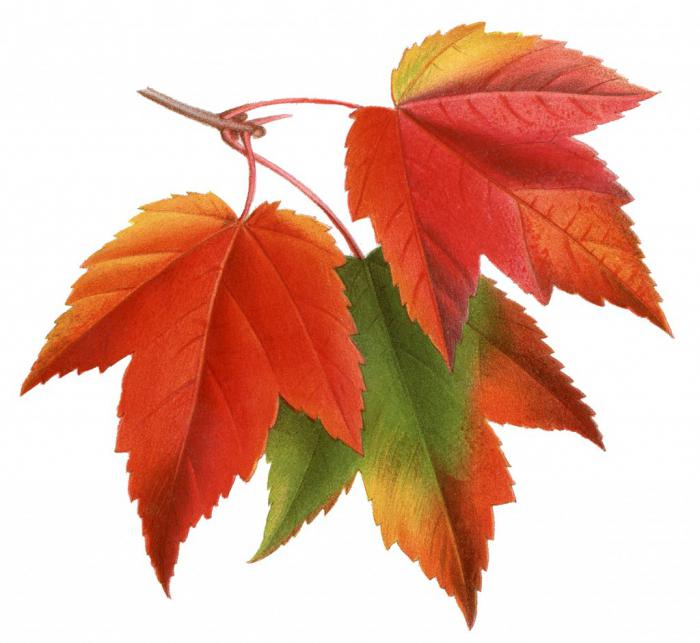 Maple leaf in autumn is unusually beautiful. It can be yellow, red, orange. There are variegated, spotted. During the fall of fantastically beautiful maple leaves, it becomes unusually fabulous in the forest and in parks.
And how beautiful are the golden landscapes during the period of bright autumn with maple forests!
Many artists and photographers replenish their collections of works with beautiful works at this time of the year: still lifes, landscapes.
→ We draw Maple Leaf
This lesson fell into the category of easy, which means that in theory even a small child can repeat it. Naturally, parents can also help small children draw a maple leaf. And if you consider yourself a more advanced artist, then I can recommend the lesson "" - it will require more perseverance from you, although it will be no less interesting.
What you need
In order to draw a maple leaf, we may need:
- Paper. It is better to take medium-grained special paper: it will be much more pleasant for novice artists to draw on this particular paper.
- Sharpened pencils. I advise you to take several degrees of hardness, each must be used for different purposes.
- Eraser.
- Stick for rubbing hatching. Can be used plain paper twisted into a cone. She will rub the shading, turning it into a monotonous color.
- A little patience.
- Good mood.
Step by step lesson
Each plant is unique and inimitable. This lesson is only a small part of the story on how to draw a maple leaf. It is best to practice drawing from life, this approach will give you the necessary knowledge on the structure of plants and how they interact with light and shade. At worst, look at the photos on the Internet.
By the way, in addition to this lesson, I advise you to turn your attention to the lesson "". It will help improve your mastery or just give you a little pleasure.
Simple drawings are created using paths. It will be enough for you to repeat that, and only that, that is shown in the lesson to get an acceptable result, but if you want to achieve something more, then try to imagine that. that you draw in the form of simple geometric bodies. Try to sketch not with contours, but with rectangles, triangles and circles. After some time, with the constant use of this technology, you will see that it becomes easier to draw.
Tip: sketch with as light strokes as possible. The thicker the strokes of the sketch are, the more difficult it will be to erase them later.
The first step, or rather zero, is always to mark a sheet of paper. This will give you an idea of where exactly the drawing will be. If you place the drawing on half of the sheet, you can use the other half for another drawing. Here is an example of a sheet layout in the center:
We start with the workpiece. It will look like this paw:


We draw a stem.

And now a little torn lower part of the leaf.

We note the sharp ends of the maple leaf at the corners.

And we begin to combine them from the bottom up.

We do this until we close the outline of the sheet. Now the auxiliary points can be erased.

Finish the leaf, adding more detail to it. It looks good.

In this lesson, I'll show you how to draw a maple leaf with a pencil step by step. This is a simple lesson that even a beginner can handle.
Before drawing a complex shape, you must imagine how it works from the inside. For example, a maple leaf is not a simple figure. But if you study its structure, it will become much easier. Here is the maple leaf:
How to draw a maple leaf - an easy step by step drawing lesson
First, look at the maple leaf in the picture above. Think about its basic shape. Look at the stem. Notice how it continues to the tip of the leaf. Look at the "ribs" of the leaf. Think about the corners where they meet the stem. Now you can draw the main shape. Always try to see the basic shape first and leave the details for later. Follow step by step instructions below.
- Draw a square....then draw a stem through the center.

2. Look at the edges of the leaves. Imagine the corners where they abut against the stem. Note that they fold into a "V" at the top and sides of the sheet.

3. Now draw the outline of the sheet. You can refer to the square you drew in the first step.

To make it easier for you, the main lines are highlighted in color below:
3.1 At the bottom of the sheet, draw the shape of a flattened letter "W". At the top, draw an inverted "V".

3.2 Now draw 3 letters "J" (2 inverted).

3.3 Now draw the number "7" on the right and the letter "Z" on the left side of the sheet.
 4. Now draw the outer corrugated shape of the edges of the sheet.
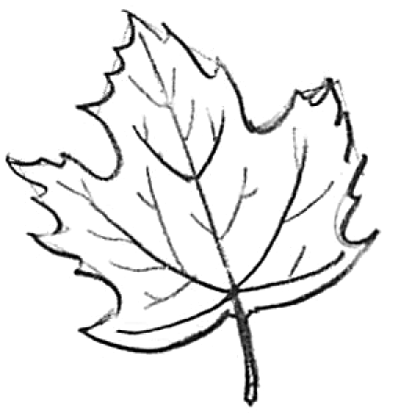
5. The maple leaf drawing is ready!
Lesson translated from www.drawinghowtodraw.com
Source: https://hanen.ru/en/barberry/maple-maple-leaves-description-how-to-draw-a-maple-leaf.html
0 Response to "How to Draw a Norway Maple Leaf Easy"
Post a Comment